

How Vending Machines Make Money for Operators

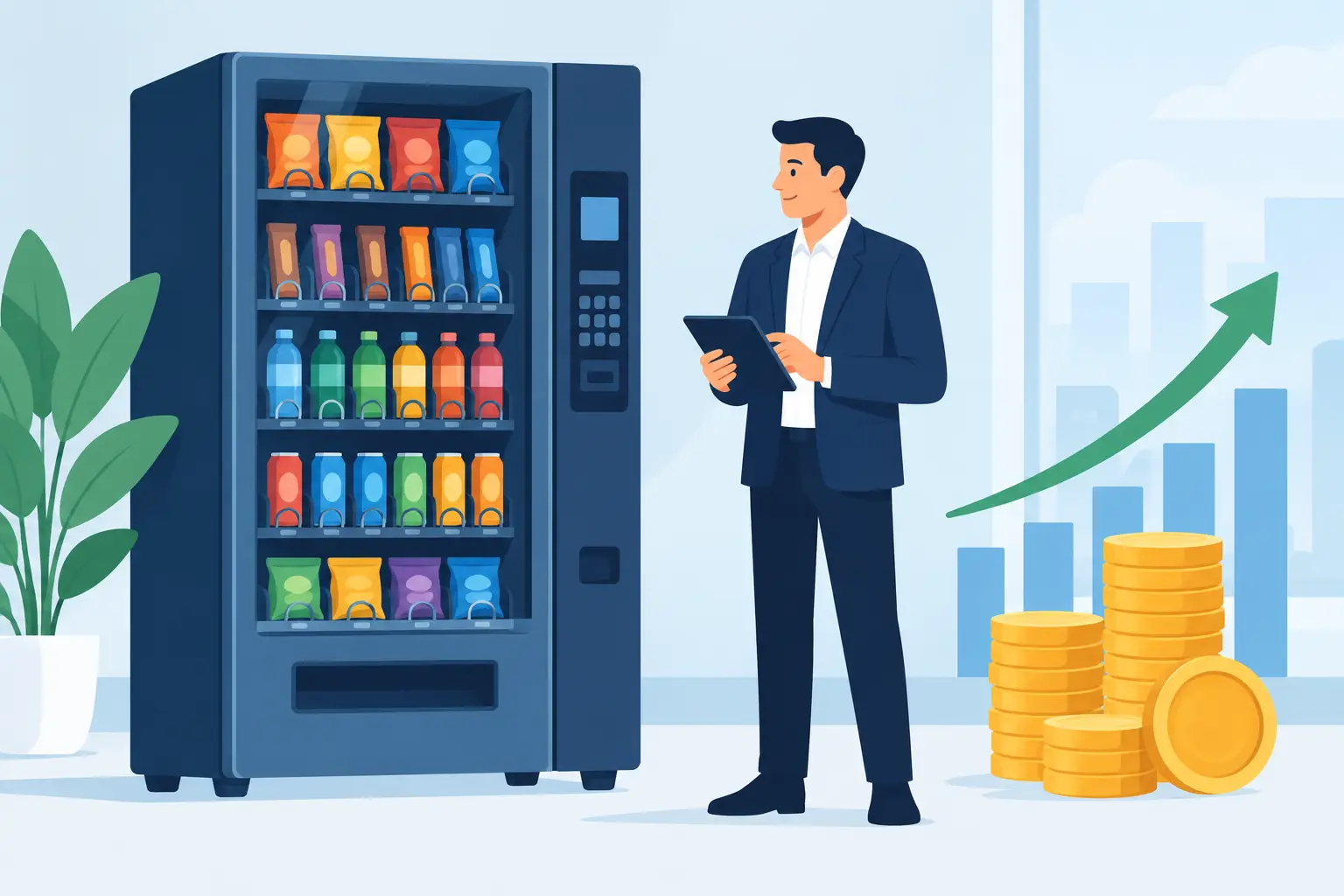
A vending machine can sell the same bottle of water all day and still produce very different results depending on where it sits, what it costs to stock, and how often customers use it. That is the practical answer to how vending machines make money: operators earn the difference between sales revenue and the total cost of products, equipment, payment processing, service, and route operations.
For a first machine or a growing route, the goal is not simply to find a low-cost machine. The goal is to place the right machine in a location with repeat demand, build a product mix people will actually buy, and keep the machine working with minimal downtime. Revenue is visible on the machine’s sales report. Profit comes from the operating decisions behind it.
How Vending Machines Make Money: The Basic Model
Every vend starts with a retail price. If a snack sells for $1.75 and your delivered product cost is $0.75, the gross margin before operating expenses is $1.00. A drink that sells for $2.25 and costs $1.05 leaves $1.20 before card fees, commissions, fuel, repairs, and other costs.
The simple calculation is:
Sales revenue – product cost – operating expenses = net profit
Sales revenue depends on three things: traffic, conversion, and average sale value. A machine in a busy office may have hundreds of people nearby, but it will not necessarily outperform a smaller apartment building if office employees bring their own food and drinks. A strong location has a specific reason for people to buy – limited nearby options, long shifts, waiting time, or a customer base that values convenience.
Average sale value matters, too. A snack-and-drink combo machine may create more frequent purchases in a smaller space. A beverage machine can perform well where cold drinks are the main need. Specialty equipment can support higher-margin products when it matches the setting, such as laundry supplies in a laundromat or convenience items at a bowling center.
Location Drives More Profit Than Machine Count
A vending route with five productive placements can be more valuable than a route with 15 weak ones. Machines do not create demand on their own. They capture demand that already exists at the location.
Good placement opportunities usually share a few characteristics: regular foot traffic, limited access to competing food or retail options, enough dwell time for customers to notice the machine, and a decision-maker willing to support the service. Manufacturing facilities, apartment communities, offices, laundromats, auto shops, warehouses, recreation centers, and waiting areas can all work, but the product mix should change with the audience.
For example, a warehouse with shift workers may produce steady demand for energy drinks, bottled water, salty snacks, candy, and meal-replacement items. An office could respond better to sparkling water, better-for-you snacks, coffee products, and premium options. A laundromat may need detergent, dryer sheets, beverages, and small snacks more than a broad candy selection.
Commission arrangements affect the numbers. Some locations ask for a percentage of gross sales, while others value vending as an employee or tenant amenity and may not require a commission. Neither option is automatically better. Paying a commission can be worthwhile when the location has strong volume and low service hassle. The key is to price the arrangement into your projected profit before installing equipment.
Evaluate demand before buying or placing
Ask practical questions: How many people are on site each day? What hours are they there? Is food available nearby? Are there existing machines, and do they appear busy? Is there a secure, accessible place with power? Can the machine be restocked without disrupting the business?
A location that looks busy for an hour may be quiet for the rest of the day. A site with lower traffic but consistent daily users can be easier to forecast and service. Operators make better decisions when they evaluate weekly purchasing behavior, not just a quick walk-through.
Product Margins Are Only Part of the Equation
Vending is often described as a markup business, but not every high-markup item is a good vending item. A product that looks profitable on paper but expires, moves slowly, or occupies a valuable selection can reduce your actual return.
Successful operators balance familiar sellers with tested upgrades. Standard drinks and recognizable snack brands often provide dependable turnover. Higher-priced energy drinks, protein bars, premium water, healthier snacks, and location-specific products can raise the average transaction when customers want them. The right mix depends on local demand and your machine’s capacity.
Wholesale cost is not the only inventory expense. Include delivery or pickup costs, spoilage, shrinkage, and time spent receiving and loading products. A low-cost item that requires frequent emergency restocking can be less attractive than a product with a slightly lower margin but consistent movement.
Pricing should also reflect the location and payment method. Customers generally accept convenience pricing when the machine is clean, stocked, cold where applicable, and easy to use. Underpricing can create sales without producing enough cash to cover card fees and service. Overpricing can slow movement and leave products sitting too long. Test prices thoughtfully, then review what happens to unit sales and gross profit.
Cashless Payments Can Increase Sales
Cash is still used in some locations, but card readers and mobile payments have changed how many customers buy from vending machines. A customer without bills or coins can walk away from an otherwise good purchase. Cashless acceptance gives that customer a way to complete the sale.
It does add expense. Card processing fees, reader costs, and connectivity charges need to be included in your operating model. Yet the added sales, higher average transaction values, and sales data can justify those costs in many commercial locations.
Modern payment systems can also show sales by machine, product, day, and time period. That information helps an operator identify a slow column, spot a stockout, compare locations, and schedule restocks more efficiently. For an expanding fleet, those controls can be as valuable as the payment acceptance itself.
AI-powered smart coolers and unattended retail systems work differently from conventional spiral machines, but the profit principle is the same. They make money when they offer convenient access to products that customers want, while the operator maintains pricing, inventory accuracy, and a reliable customer experience. Their advantage can be broader product presentation and a more store-like purchase experience in the right environment.
The Expenses That Decide Real Profit
A machine’s gross sales can be encouraging, but net results require a full cost view. Equipment cost is one part of the investment. New machines may offer updated components, better payment compatibility, warranty coverage, and a cleaner presentation. Used machines can lower startup cost and may be a practical fit for an operator who understands the condition, capacity, and available upgrades.
Other regular expenses include product purchases, credit card fees, location commissions, electricity, repairs, insurance, taxes, vehicle fuel, and labor. A single machine close to home may be easy to service. Ten machines spread across a large area can create a route problem if sales at each stop do not justify the drive.
Downtime also costs money. A machine with a jammed bill acceptor, failed refrigeration system, or empty best-selling column is not just a maintenance issue. It is lost sales and a risk to the location relationship. Buying commercial equipment suited to the intended product category, keeping service parts available, and responding quickly when problems arise protect revenue.
A simple monthly example
Suppose a snack-and-drink machine produces $2,400 in monthly sales. Inventory costs are $1,080, leaving $1,320 in gross profit. If payment fees total $95, the location commission is $120, fuel and route costs are $85, and you set aside $120 for maintenance and other overhead, estimated net profit is $900 for the month.
That example is not a guarantee. Some locations will do much less, while a well-matched high-traffic placement can do far more. It shows why operators should avoid judging a machine solely by its purchase price or a location solely by its sales total.
Route Management Turns Sales Into a Business
The first machine teaches the fundamentals. Scaling requires systems. Operators need a dependable way to track sales, inventory, service calls, product costs, cash collections if applicable, and location agreements. Without records, it is easy to keep servicing a weak machine because it feels busy or to miss the fact that a top seller is repeatedly out of stock.
Restocking frequency should match sales velocity. Going too often wastes labor and fuel. Waiting too long creates empty slots and lost purchases. Telemetry and cashless sales reporting can make this easier, but even a simple spreadsheet can help a smaller operator identify what is selling and where profit is coming from.
As the route grows, standardizing equipment can simplify service, parts, and stocking. That does not mean every location needs the same machine. A beverage machine, combo unit, specialty machine, or smart cooler should fit the opportunity. It means choosing equipment intentionally instead of accumulating machines that are difficult to maintain or poorly matched to the account.
Start With an Investment You Can Operate Well
A lower-priced used machine can be a sensible entry point if the location is proven and the equipment is in serviceable condition. A new card-reader-ready machine may be the better investment when cashless sales, appearance, reliability, or warranty support are central to winning the account. The best choice depends on your available capital, technical comfort, location requirements, and plans for growth.
VendingMachinesForSale.net offers conventional, specialty, used, and smart vending equipment so operators can compare machine formats against the opportunity rather than forcing every location into the same setup.
The strongest next move is usually not buying the most expensive machine or filling every slot with the highest-priced product. It is finding one placement with clear demand, selecting equipment that fits it, and measuring the results closely enough to make the second machine a smarter decision than the first.