

Vending Machine Location Contract Template Guide

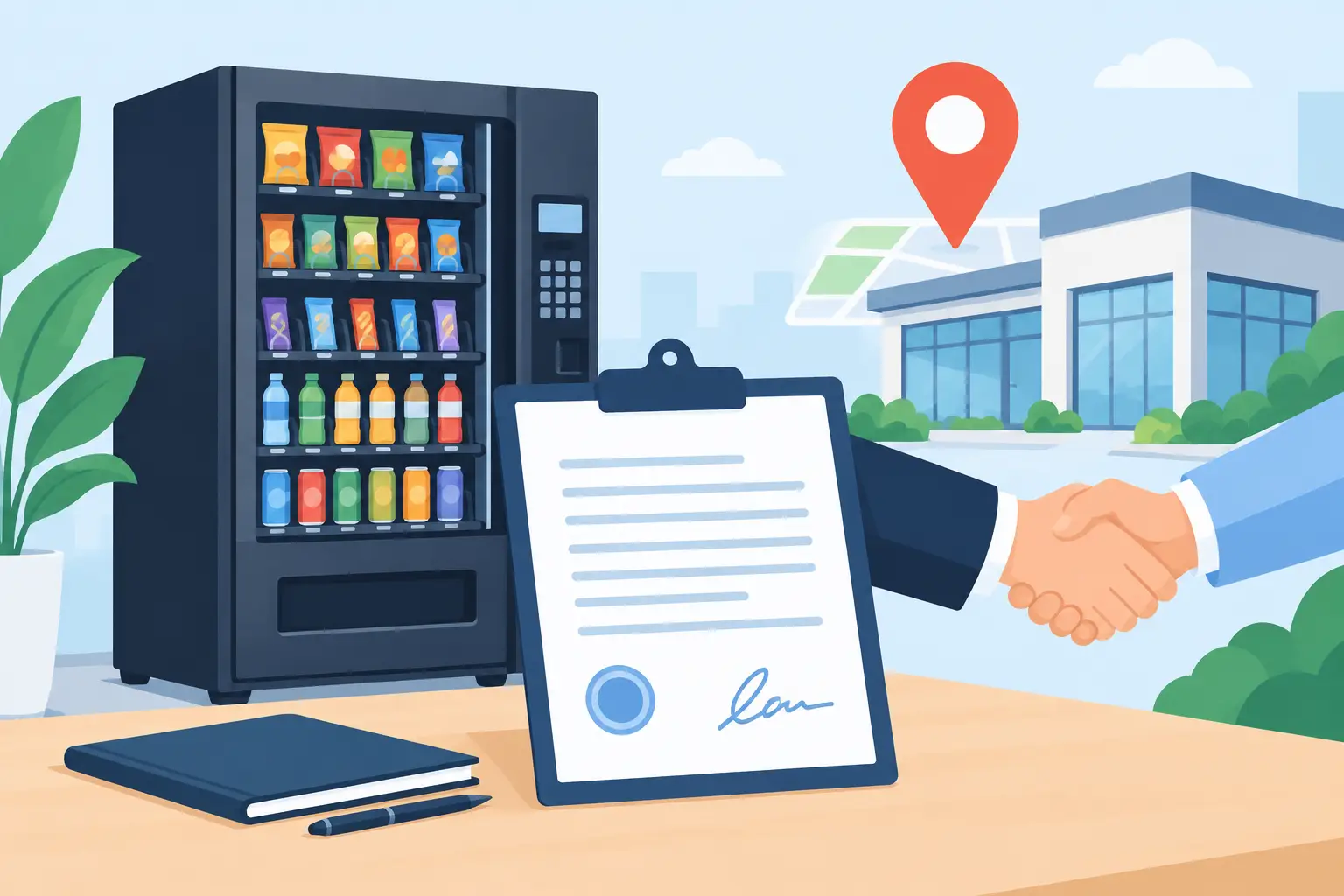
A good location can turn one vending machine into a dependable monthly asset. A bad agreement can leave you paying for damaged equipment, unexpected commission demands, or removal with little notice. This vending machine location contract template guide helps operators put the business terms in writing before a machine is delivered.
For a first machine in a small office, a short, clear agreement is usually enough. For a busy apartment building, manufacturing facility, laundromat, or smart-store installation, the contract should be more detailed. The goal is not to make the arrangement complicated. It is to make responsibilities, money, access, and exit terms clear enough that both sides know what to expect.
What a Location Contract Should Do
A vending location contract is an agreement between the vending operator and the property owner, manager, or business representative. It gives the operator permission to place and service a machine at the location. It also sets the financial arrangement, whether that means no commission, a percentage of sales, a fixed monthly fee, or another arrangement.
The contract protects the location, too. It tells the manager who to contact for service, which products will be stocked, who supplies electricity, and how complaints will be handled. When a machine takes card payments or uses a cashless smart cooler system, the agreement can also clarify that the operator controls payment processing and customer transaction data.
Avoid relying only on a verbal promise. Management changes, buildings sell, and busy owners forget conversations. A signed document gives you a record of the placement terms and prevents simple misunderstandings from becoming route problems.
Vending Machine Location Contract Template: Core Clauses
Your vending machine location contract template should fit the machine type and the location, but several clauses belong in nearly every agreement. Keep the language plain. A location manager should be able to read it quickly and understand the deal without sending it through several rounds of review.
Parties and placement address
Start with the legal name of your vending business and the legal name of the location owner or operating business. Add the full street address, including the specific building, suite, break room, lobby, laundry area, or other placement area when relevant.
State the machine type and quantity. For example: one refrigerated beverage machine, one snack-and-drink combo machine, or two AI-powered smart coolers. If you are installing a used machine, identify it by model or serial number if available. This avoids confusion if the location has equipment from another operator.
Ownership of the machine and products
State that the vending equipment remains your property at all times. The location receives permission to have the machine on-site, but does not own it, lease it, or have the right to move, open, repair, sell, or remove it.
The agreement should also state that the operator owns the inventory until it is sold. This matters if a contract ends suddenly or the business closes. It gives you the clear right to retrieve your machine and remaining product.
A simple clause can read: “All vending machines, payment devices, telemetry equipment, keys, inventory, and related accessories remain the sole property of Operator.” Have a local attorney review your final wording, especially if you operate across multiple states.
Term and renewal
The term is the length of the agreement. New operators often use a one-year initial term with automatic month-to-month renewal after that period. This gives you time to recover delivery, setup, card reader, and equipment costs without trapping the location in a long commitment.
A shorter 60- or 90-day trial can work for a new account, especially when traffic is uncertain. The trade-off is that you may invest in a machine and installation before the placement has proven itself. For a higher-cost smart store or specialized machine, a longer initial term may make more business sense.
Termination notice
Both parties need a way to end the relationship. A 30-day written notice is common for standard vending placements. For locations with lower sales or a machine that can be relocated easily, 15 days may be enough. For larger installations, consider 60 days so you have time to schedule removal and protect the equipment.
Include an immediate removal right if the location closes, loses its lease, blocks access, damages the machine, or fails to meet a promised payment obligation. You should also reserve the right to remove a machine if sales are not sufficient to support regular service. This is especially useful when a location expected 100 employees but only has 20 people on-site most days.
Commission, rent, or no-fee placement
Put the exact financial arrangement in writing. Do not write “commission to be discussed.” State the percentage or dollar amount, what sales it applies to, and when payment is due.
If you pay commission, clarify whether it is calculated from gross sales, net sales after sales tax, or another defined figure. Gross sales are simple, but they can reduce your margin quickly at a location with low volume or high card processing costs. A fixed monthly fee may be easier to manage, but it becomes risky when seasonal traffic drops.
Many office, warehouse, and employee-break-room placements work well with no commission. The location receives a convenient amenity while employees get access to snacks and drinks. A property manager with competing vendors or premium foot traffic may expect a share of sales. It depends on the account, your projected volume, and the machine investment required.
Electricity, internet, and operating access
State that the location provides a standard electrical outlet at no charge unless you agree otherwise. For card-reader-enabled machines, smart coolers, and connected equipment, identify whether the machine will use cellular service, Wi-Fi, or a hardwired connection. Do not promise Wi-Fi access unless the location confirms it can provide a stable connection.
The contract should give you reasonable access during business hours to restock, clean, collect cash, troubleshoot, and repair the equipment. If the machine is behind a locked door or security desk, name the access process. A vending machine that cannot be serviced on schedule becomes an unprofitable placement fast.
Service, cleanliness, and product selection
State that you will stock and maintain the machine in a commercially reasonable manner. Avoid guaranteeing that every product will always be available. Supply interruptions, changing customer demand, and equipment repairs happen.
You should retain control over product selection, pricing, and planogram decisions. Still, it is smart to invite reasonable requests. An office may want more zero-sugar drinks, while a bowling center may sell more energy drinks and packaged snacks. Stocking to the location is one of the simplest ways to improve turns without adding machines.
Include a service contact name, phone number, or email field in the agreement. Also state that the location will promptly report outages, damage, product issues, or payment problems. Quick reporting helps protect sales and prevents a small issue from becoming a frustrated customer complaint.
Damage, loss, and relocation
Your agreement should prohibit anyone at the location from unplugging, moving, or altering the machine without your approval. If the machine is damaged by the location, its employees, contractors, or guests, state that the location is responsible for reasonable repair or replacement costs.
There is a balance here. A small business owner may resist broad liability language, particularly in a public lobby. Keep the clause focused on preventable actions under their control, such as moving a machine during remodeling or allowing unauthorized access to it.
If the location wants the machine moved to another floor or room, require advance notice and operator approval. Even a short move can require electrical planning, a dolly, labor, and re-leveling. It should not be treated as a casual request.
A Simple Contract Outline You Can Adapt
Use the following structure as a practical starting point. Replace the bracketed information with your terms and have the final agreement reviewed for your state and business situation.
“[Operator Name] is authorized to place and operate [number and type of machines] at [location address and designated area]. Equipment remains the exclusive property of Operator. This agreement begins on [date] and continues for [term], then renews month to month unless either party provides [30] days’ written notice. Location will provide reasonable access and one standard electrical outlet for each machine. Operator will service, stock, and maintain the equipment and will determine product selection and retail pricing. Location will receive [no commission / __% of defined sales / $__ per month], paid by [payment schedule]. Location will not move, unplug, modify, or allow unauthorized access to equipment. Operator may remove equipment upon termination, closure of the location, lack of reasonable access, equipment damage, or insufficient sales.”
Add signature lines for both parties, printed names, titles, dates, and a preferred email address for notices. A signed PDF is typically practical for smaller accounts, although some larger companies may require their own vendor agreement.
Match the Contract to the Machine Investment
A basic used snack machine in a small waiting area carries a different level of risk than a new combo unit with a card reader or an AI-powered unattended retail setup. The more you invest in equipment, delivery, installation, and inventory, the more specific your location agreement should be.
Before sending a contract, estimate the account’s traffic, operating hours, nearby food options, and expected average transaction. Then choose equipment that supports the opportunity. A compact beverage machine may be the better fit for a small salon, while a larger combo machine or smart cooler can make more sense in a high-traffic apartment building or warehouse. VendingMachinesForSale.net offers equipment across those placement types, but the location economics should lead the machine decision.
Do not let an attractive location name replace basic due diligence. Ask where the machine will sit, who has access, whether the building has overnight traffic, and whether another vendor recently left. Those answers often tell you more about potential sales than a verbal promise of “lots of people.”
A clear contract will not make a weak location profitable, but it will help you protect your machine, establish professional expectations, and move quickly when a placement no longer works. Put the terms in writing, serve the account well, and keep your fleet focused on locations that earn their space.